
 Ink Brands
 Why Are Ink Cartridges So Expensive?
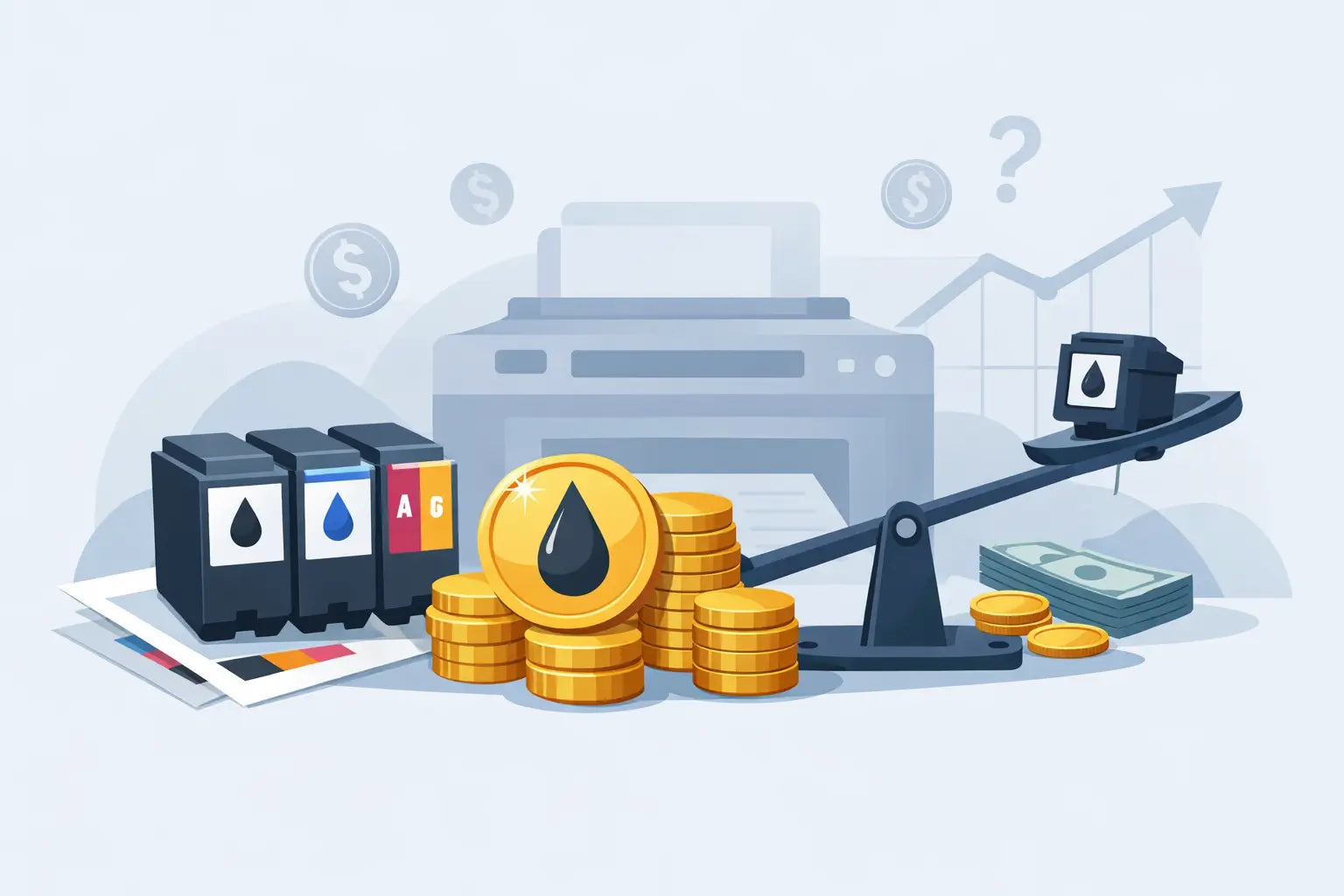
You only notice how pricey printer ink feels when a cartridge runs out at the worst possible moment - right before an assignment is due, a shipping label needs printing, or the office is trying to get invoices out the door. If you’ve ever asked why are ink cartridges so expensive, you’re not imagining it. Compared with many other household or office supplies, cartridge prices can seem surprisingly high.
The short answer is that you’re not just paying for coloured liquid in a plastic shell. You’re paying for a tightly controlled product that has been designed to work with a specific printer, deliver consistent results, avoid leaks, survive storage and transport, and generate profit in a market where printers themselves are often sold very cheaply. Once you look at how the printer industry works, the price starts to make more sense - even if it still feels frustrating at the checkout.
Why are ink cartridges so expensive in the first place?
A big part of the answer sits in the business model. Printer manufacturers often keep the upfront cost of printers relatively low to encourage sales. That helps them get more machines into homes and offices, but they still need to make money over the life of the printer. Consumables such as ink and toner are where a large share of that profit is made.
This is sometimes compared to razors and blades. The main device can be sold with slim margins, while the repeat-purchase items carry higher margins. For printer brands, cartridges are not an afterthought. They are a major revenue stream.
There’s also the issue of scale. A printer might be a once-every-few-years purchase. Ink cartridges are bought again and again. That means manufacturers put a lot of effort into controlling cartridge design, compatibility, packaging, regional distribution, and retail pricing.
The ink itself is only part of the cost
People often hear that printer ink is expensive per millilitre and assume the raw ink must be outrageously costly to make. In reality, the liquid inside the cartridge is only one piece of the total cost.
A cartridge is a manufactured component with a very specific job. Depending on the printer and brand, it may include a printhead, a chip for communication with the printer, built-in sensors, pressure regulation features, seals to stop drying, and housing that has to fit perfectly. If any of those parts fail, print quality suffers or the printer may reject the cartridge altogether.
Manufacturers also spend heavily on research and testing. Ink has to dry quickly without smudging, produce accurate colour, resist fading, and flow through extremely fine nozzles without clogging. That level of precision is not cheap to develop, especially across multiple printer models.
So while the amount of ink in a cartridge may not look like much, the product you’re buying is more complex than it appears from the outside.
OEM cartridges cost more for a reason
Genuine or OEM cartridges are made by the same brand that made your printer. They are usually the most expensive option, but that price reflects more than brand name alone.
OEM manufacturers design both the printer and the cartridge to work together. They control the chemistry, firmware, fit, and print performance. For customers who want maximum predictability, especially in business settings where downtime is a hassle, that can be worth paying for.
You’re also paying for brand-backed consistency. OEM cartridges are produced to tight specifications, and that matters if you print client documents, school materials, labels, photos, or anything where quality and reliability are important.
That said, higher price does not always mean better value for every user. If your printing is mostly everyday black text, homework sheets, or draft documents, the premium may not always be necessary.
Chips, patents and printer lock-ins affect pricing
Another reason cartridges stay expensive is that manufacturers work hard to protect their cartridge ecosystem. Many cartridges use chips that communicate with the printer, report ink levels, and verify compatibility. Firmware updates can also affect whether certain cartridges are accepted.
This creates a level of lock-in. Once you own a printer, you’re generally limited to cartridges designed for that model. You can’t treat printer ink like paper and grab any option off the shelf.
Patents and proprietary designs also reduce competition, especially for newer printer models. Where there’s less competition, prices tend to stay higher. Over time, more alternatives may enter the market, but early on, customers often have fewer choices.
Small cartridges can make the price feel worse
One of the biggest frustrations for customers is not just the price of a cartridge, but how quickly it seems to run out. Standard-yield cartridges can contain less ink than many people expect, particularly in lower-cost home printers.
That’s where the real pain point often sits. A cartridge may not look too bad as a one-off purchase, but if you’re replacing it frequently, your running costs add up fast.
This is why page yield matters more than sticker price alone. A cheaper cartridge that prints very few pages can cost more per page than a higher-capacity option. High-yield or XL cartridges often have a higher upfront cost, but they can deliver better value over time if you print regularly.
Retail, freight and local supply all play a role
Australian customers also deal with practical costs that affect pricing. Imported printer consumables move through manufacturing, shipping, warehousing, and retail channels before they reach your door. Currency movements, freight costs, and stock availability can all influence the final price.
For regional and remote customers especially, logistics matter. Keeping a broad range of cartridges in stock across many printer brands and models is not simple. There are carrying costs, customer support costs, and returns handling to consider as well.
None of that means every high cartridge price is justified. It does mean the shelf price reflects more than just what’s inside the cartridge.
Why cheaper compatible cartridges exist
If OEM cartridges are expensive, it’s fair to ask why compatible cartridges can often be sold for much less.
Compatible or aftermarket cartridges are made by third-party manufacturers rather than the original printer brand. Because those suppliers did not develop the printer itself, and often operate with different cost structures, they can offer lower pricing. They are not carrying the same brand overheads, and they are usually competing directly on value.
For many home users and businesses, compatibles are a practical way to reduce printing costs. A good compatible cartridge can deliver reliable everyday performance at a significantly lower price than OEM.
The trade-off is that quality can vary between suppliers. Some compatibles work very well. Others may have inconsistent yield, poorer colour accuracy, or compatibility issues. That’s why buying from a specialist retailer matters. You want cartridges that have been selected carefully, matched clearly to your printer, and backed by proper support if something goes wrong.
How to spend less without cutting corners
If you print regularly, the better question is often not just why are ink cartridges so expensive, but how can you reduce the cost without creating new problems.
The first step is to check whether you’re buying the right cartridge type for your usage. If you print often, high-yield cartridges usually make more sense than standard ones. If your printer supports compatible cartridges and your printing is mostly routine documents, switching from genuine to a trusted aftermarket option can deliver real savings.
It also helps to avoid emergency buying. When you only shop once the printer stops, you’re more likely to overpay or grab the wrong cartridge in a rush. Keeping a spare on hand, especially for a busy home office or small business, gives you more flexibility to choose on price and delivery.
Printer choice matters too. Some printers are inexpensive to buy but costly to run. Others have better long-term economy. If you print a lot, it’s worth looking beyond the purchase price of the printer and thinking about what replacement cartridges will cost over the next year.
For Australian households and businesses, there’s real value in buying from a supplier that makes compatibility easy to check, explains the difference between genuine and compatible options in plain language, and stands behind the products it sells. That’s where retailers such as Inkspot can make the process a lot less confusing.
At the end of the day, ink cartridges are expensive because the market has been built that way - through tight compatibility, repeat-purchase economics, and products that are more engineered than they look. The good news is that expensive does not always have to mean unavoidable. With the right cartridge, the right supplier, and a little planning, printing costs can be a lot more manageable.