 Ink Brands
 Which Cartridge Yields More Pages? Clear Guide
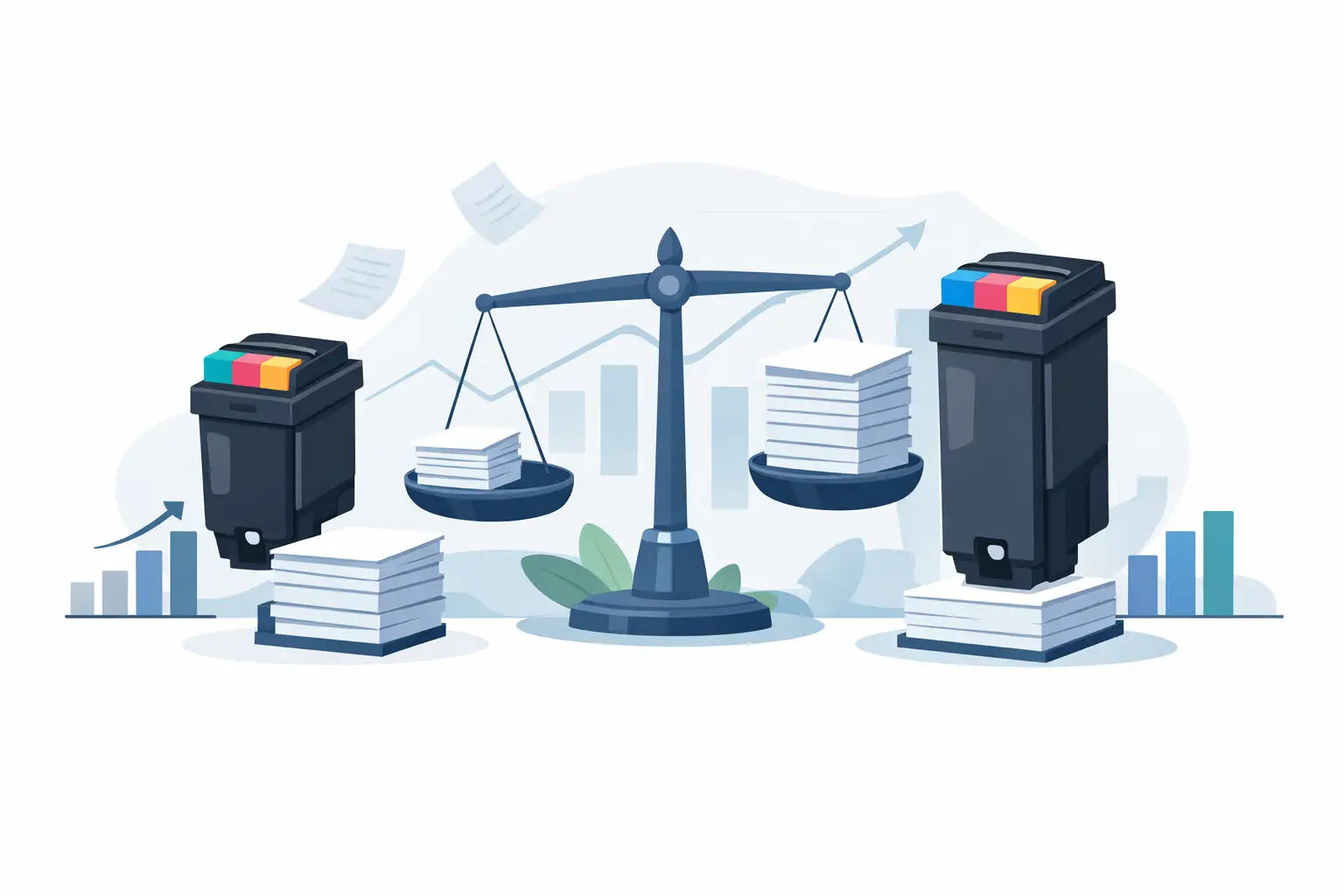
A cheap cartridge can be the most expensive choice on your desk. If you are asking which cartridge yields more pages, the answer is usually a high-yield or XL version of the same cartridge - but the label alone does not tell the whole story. Your printer model, the type of cartridge, what you print and the way page yield is measured all affect how long a replacement will really last.
For home printing, study notes and occasional forms, a standard cartridge may be perfectly sensible. For a busy home office or small business, choosing the higher-capacity option can reduce both your cost per page and the number of times you have to stop work to replace supplies.
Which cartridge yields more pages: standard or high-yield?
When a printer brand offers standard and high-yield cartridges for the same machine, the high-yield cartridge generally prints more pages. It may be called XL, high yield, high capacity, extra large or, for laser printers, an extended-yield toner. It contains more ink or toner than the standard version, while fitting the same printer.
A standard black ink cartridge might be rated for around 200 pages, while the XL version for that printer could be rated for 500 pages or more. The upfront price is higher, but the price per printed page is commonly lower. That makes high-yield cartridges a practical choice for anyone printing regularly.
The key word is "same". Compare cartridges designed for the exact same printer and in the same colour. A high-yield black cartridge will normally outlast a standard black cartridge, but it is not useful to compare it directly with a colour cartridge or a toner made for another printer.
Why the bigger cartridge is not always best
High-yield is usually better value when you use your printer often enough to finish the cartridge before it sits unused for a long period. Inkjet printheads and cartridges can dry out if a printer is left untouched for months, particularly in warm or dry rooms. If you print only a handful of pages a year, a standard cartridge may be the more sensible spend.
There is also the cash-flow factor. A small office that prints invoices, labels and reports every week will usually benefit from buying high yield. A student printing a few assignments across a semester may prefer the lower upfront cost of a standard cartridge. The right choice is not simply the cartridge with the largest number on the box. It is the one that suits your actual printing pattern.
Understanding page yield ratings
Page yield is the estimated number of pages a cartridge can print under a standard test. It gives shoppers a useful way to compare standard and high-yield options, but it is not a promise that every household or office will achieve exactly that number.
For ink and toner, manufacturers commonly base their ratings on documents with roughly 5% page coverage. Picture a mostly white A4 page with a short letter, a small logo or a few lines of text. A page filled with black text, a colour brochure, a school project with photos or a border-heavy invoice uses far more ink or toner.
That is why a cartridge rated for 1,000 pages can run out sooner in one office than another. The rating is still valuable because it offers a consistent comparison point. If one compatible black cartridge is rated at 600 pages and another for the same printer is rated at 1,200, the higher-rated option should provide about twice the output under similar conditions.
What changes your real-world yield?
Your print settings make a noticeable difference. Draft mode, greyscale printing and double-sided documents can lower supply use, while high-quality photo printing and dense colour graphics use it faster. Cleaning cycles on inkjet printers also consume ink, especially after the printer has been idle or when print quality problems need attention.
The document itself matters just as much. A one-page black-and-white contract uses very little compared with a full-page colour flyer. Even black text can be demanding when a bold font, large headings or heavy shaded backgrounds are used throughout.
For colour inkjet printers, remember that colour cartridges may be used even when you think you are printing in black only. Some printers blend small amounts of colour ink to improve black tones or support maintenance routines. Selecting a true black-and-white or greyscale setting can help, although printer behaviour varies by model.
Ink cartridges versus toner cartridges
Laser toner cartridges usually have a much higher page yield than inkjet cartridges. This is one reason laser printers are popular in workplaces that print large volumes of text. A standard toner may be rated for 1,000 to 2,000 pages, while a high-yield toner can reach several thousand pages, depending on the printer.
That does not mean toner is automatically the cheaper answer for every buyer. Laser printers usually cost more to buy, and some models require additional consumables over time, such as drums, waste toner bottles or maintenance units. Inkjet printers are often more affordable initially and can be an excellent fit for homes, photos and lower-volume colour printing.
Compare the cost per page within the printer type you already own before deciding. Replacing an inkjet printer with a laser printer only makes sense if your regular printing volume and document mix support the change.
Genuine or compatible: does one yield more?
A genuine cartridge is made by the printer manufacturer. A compatible cartridge is made by another manufacturer to work with a specified printer model. Either can offer standard or high-yield capacity, so genuine versus compatible does not by itself determine page yield.
The useful comparison is the stated page yield, cartridge capacity and price per page. A quality compatible high-yield cartridge may provide a comparable or higher stated yield than a standard genuine option at a lower purchase price. This can be particularly helpful for businesses ordering several black cartridges or toner units at a time.
Quality matters, though. Poorly made alternatives can cause weak prints, leaks, recognition errors or inconsistent output. Buy from a specialist supplier that clearly identifies compatible printer models, provides product specifications and stands behind its range. At Inkspot, checking your printer model first helps ensure you are comparing the right cartridge rather than relying on a similar-looking code.
How to compare cartridge value before you buy
Start by finding the cartridge number your printer uses. Do not assume that cartridges from the same brand or printer series fit one another. Then compare standard, XL or high-yield choices available for that exact cartridge number.
Next, look at the listed page yield and divide the cartridge price by that number. For example, a $40 cartridge rated for 400 pages has an estimated cost of 10 cents per page. A $65 high-yield version rated for 900 pages works out at about 7.2 cents per page. The high-yield cartridge costs more at checkout but less over its working life.
Use this figure as a guide, not an exact forecast. If your work involves photos, posters, colour presentations or heavily branded paperwork, allow for a higher real cost per page. If you mostly print plain text in draft mode, you may get closer to - or occasionally beyond - the published rating.
Also consider the inconvenience cost. Running out of black ink before an urgent school form, shipping label or client document is due can be more frustrating than the modest saving from buying the smallest cartridge. Keeping a spare on hand is worthwhile for printers used every week.
Make every cartridge last longer
You do not need to print in poor quality to control cartridge costs. Set text documents to normal or draft quality where suitable, preview jobs before printing and avoid accidental blank pages. Use black-and-white mode for documents that do not need colour, and keep your printer switched on according to the manufacturer's guidance so it can perform normal maintenance efficiently.
For inkjet printers used occasionally, print a small page every few weeks to keep ink moving through the system. Store unopened cartridges upright in a cool, dry place and avoid fitting one until you are ready to use it. These simple habits help you receive the value you paid for rather than losing ink to avoidable cleaning cycles or dried nozzles.
The best cartridge is the one that matches your printer and your workload. If printing is a regular part of your week, a high-yield cartridge is often the calmer, lower-cost choice: fewer replacements, fewer interruptions and more pages ready when you need them.