
 Ink Brands
 OEM Versus Aftermarket Toner Explained
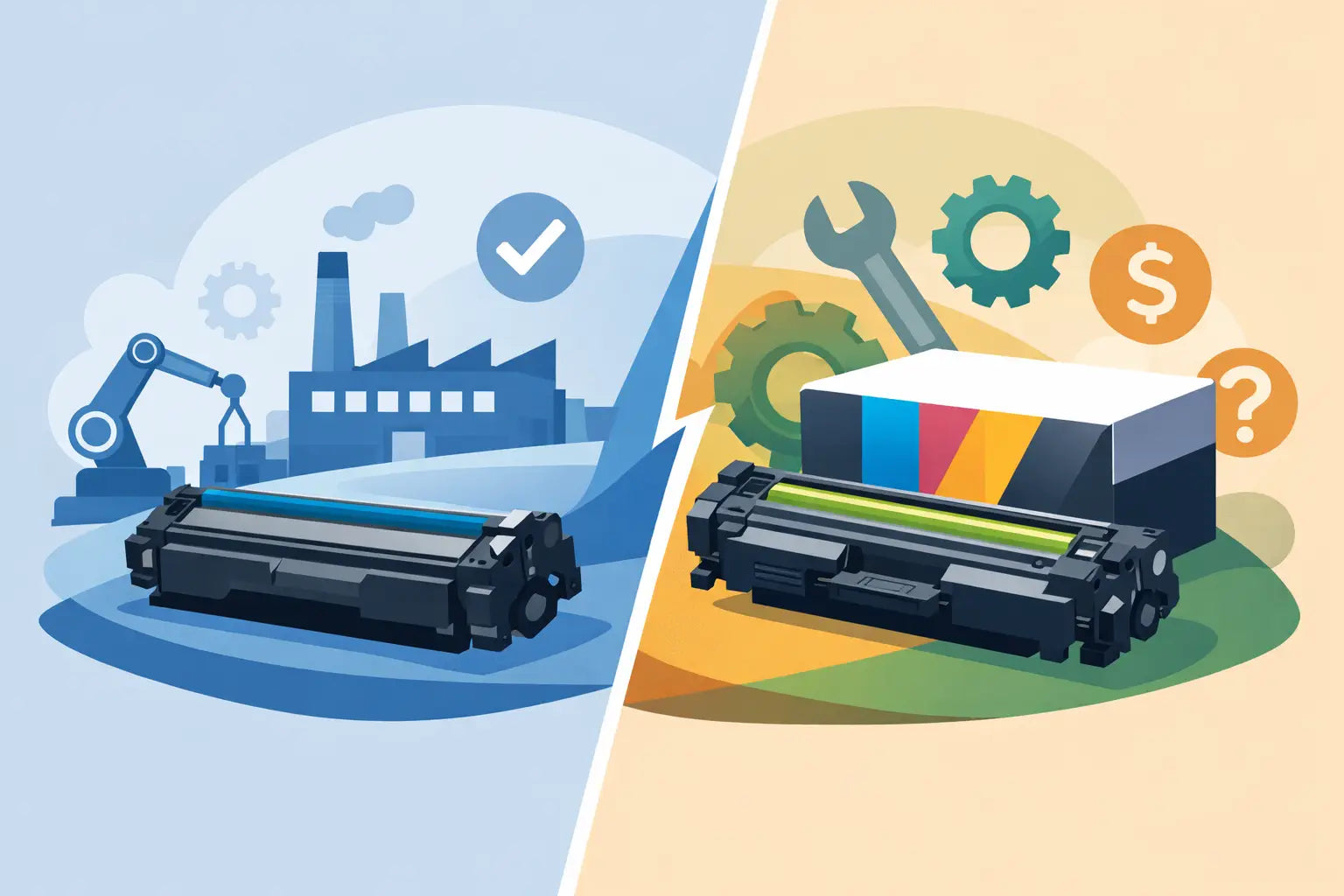
A toner cartridge can look like a simple purchase right up until you see the price gap. One option is the original brand cartridge your printer maker recommends. The other is a cheaper replacement that promises similar results for less. If you are weighing up OEM versus aftermarket toner, the real question is not just which one is better. It is which one makes better sense for the way you print.
For some households and businesses, paying more for genuine toner is worth it. For others, compatible toner can cut printing costs without causing headaches. The right choice depends on your printer, how often you print, what you print, and how much risk you are comfortable with.
What OEM versus aftermarket toner actually means
OEM stands for original equipment manufacturer. In plain terms, OEM toner is made by the same brand that made your printer. If you have an HP printer, HP toner is OEM. If you use Brother, Canon or Fuji Xerox, their branded cartridges are the OEM option.
Aftermarket toner is any cartridge not made by the original printer manufacturer. You will often see it described as compatible toner, generic toner or replacement toner. These cartridges are designed to work in specific printer models, but they are made by a third-party manufacturer instead.
That difference matters because OEM and aftermarket products are built around different priorities. OEM toner is designed to match the printer brand’s own specifications. Aftermarket toner is designed to offer a lower-cost alternative that still meets everyday printing needs.
Why OEM toner costs more
Most buyers notice the price first. Genuine toner nearly always costs more, and sometimes a lot more.
Part of that comes down to research, testing and brand control. Printer manufacturers develop their own cartridges to work with their machines, and they put significant resources into product development, quality assurance and packaging. You are also paying for the brand name and the manufacturer’s support network.
There is another factor as well. Many printer brands sell printers at competitive prices and make more of their margin from consumables over time. That is one reason replacement toner can feel expensive compared with the cost of the printer itself.
For buyers who print regularly, those higher cartridge prices can add up quickly. A small office replacing multiple toner cartridges over a year will notice the difference far more than someone printing a boarding pass once a month.
Where aftermarket toner can save you money
This is where compatible toner becomes appealing. Aftermarket cartridges are usually priced well below genuine ones, which can make a real difference to households, students, remote workers and businesses trying to control overheads.
If your office prints invoices, packing slips, school worksheets or internal documents every day, lower cartridge costs can reduce your cost per page in a meaningful way. Over several orders, the savings can be substantial.
That does not automatically mean every aftermarket cartridge is the better buy. The cheapest option is not always the best value if print quality is poor, page yield is lower than expected, or the cartridge causes printer issues. Price matters, but so does consistency.
OEM versus aftermarket toner for print quality
Print quality is one of the biggest concerns buyers have, and fairly so. No one wants faded text, uneven coverage or pages that look unprofessional.
OEM toner tends to deliver the most predictable result. Because it is made specifically for the printer, output is usually sharp, stable and consistent across the life of the cartridge. That can matter if you print client-facing documents, branded materials or anything where presentation counts.
Aftermarket toner can also produce very good results, but quality can vary more between manufacturers. A well-made compatible cartridge may be perfectly suitable for everyday office printing. A poor-quality one may produce lighter text, inconsistent density or toner smudging.
This is why the supplier matters almost as much as the cartridge itself. Buying from a trusted retailer with clear compatibility information and support gives you a better chance of getting a cartridge that performs as expected.
Reliability matters just as much as price
Printing problems are not always dramatic. Sometimes it is a cartridge not being recognised. Sometimes it is streaking. Sometimes the printer throws an error message and everyone in the office wastes 20 minutes trying to sort it out.
OEM toner has the edge on reliability because it is developed by the printer manufacturer for that exact machine. In general, that means fewer surprises.
Aftermarket toner can still be reliable, especially when it comes from a reputable source, but there is a wider spread in manufacturing quality across the market. Some cartridges are made to a high standard. Others are not. That is where buyers can run into trouble if they shop purely on the lowest price and ignore product backing.
For busy workplaces, reliability often has a cost value of its own. Saving money on toner does not feel like a win if staff lose time dealing with cartridge issues.
Will aftermarket toner void your printer warranty?
This question comes up all the time, and the short answer is usually no. Using compatible toner does not automatically void your printer warranty.
What can happen is more specific. If a printer manufacturer can show that damage was caused directly by a non-genuine cartridge, they may refuse warranty coverage for that particular issue. That is different from cancelling your entire warranty just because you used an aftermarket product.
For most buyers, the practical takeaway is simple. Use toner that is made for your exact printer model, buy from a reliable supplier, and keep records of what you purchased in case a problem needs to be sorted out.
When OEM toner is the safer choice
There are situations where genuine toner makes clear sense.
If you print high-stakes documents, need exact consistency, or rely on a printer in a busy business setting where downtime is a bigger problem than cartridge cost, OEM toner can be the safer option. The same applies if your printer is new, still under close manufacturer support, or particularly fussy with cartridge recognition.
Some specialised printers also perform best with genuine supplies. If your output quality is closely tied to your professional reputation, many buyers prefer not to experiment.
When aftermarket toner is the smarter buy
Compatible toner often makes the most sense when cost control is a priority and your printing needs are more practical than perfection-driven.
If you print schoolwork, drafts, internal office paperwork, labels, forms or everyday black-and-white documents, a good aftermarket cartridge may do the job very well at a lower price. That is especially true for frequent printers who go through toner quickly and want to keep running costs manageable.
For many Australian households and SMEs, this is the sweet spot. They want dependable performance, but they also want relief from manufacturer pricing. A well-supported compatible cartridge can offer that balance.
How to choose between OEM and aftermarket toner
The best decision usually comes from asking a few basic questions.
Start with what you print. If quality is business-critical, genuine toner may be worth the premium. If most of your printing is routine, aftermarket can offer better value.
Then think about volume. The more you print, the more savings from compatible toner can stack up. On the other hand, if you print only occasionally, the price difference may not matter enough to outweigh your preference for genuine supplies.
Next, consider your tolerance for troubleshooting. Some buyers are happy to trade a little uncertainty for lower costs. Others want the most straightforward replacement possible every time.
Finally, check the supplier. Good compatibility guidance, clear returns support and a sensible guarantee matter. This is one reason many Australians prefer buying from a specialist retailer such as Inkspot rather than taking a gamble on an unknown marketplace seller.
OEM versus aftermarket toner is really a value decision
A lot of the debate around OEM versus aftermarket toner gets framed as a simple quality contest, but that misses the point. For most buyers, this is really a value decision.
OEM toner offers confidence, consistency and strong compatibility. Aftermarket toner offers lower upfront cost and, when chosen carefully, very solid everyday performance. Neither option is automatically right for everyone.
The better question is what matters most for your printer, your workload and your budget. If you want maximum certainty, genuine toner is hard to argue with. If you want to cut printing costs without cutting corners, a quality compatible cartridge can be a very sensible choice.
The good news is you do not have to pick one approach forever. Many buyers use OEM in one printer and aftermarket in another, or switch depending on what they are printing. A smart toner choice is not about following a rule. It is about buying with a clear understanding of the trade-off, so your next cartridge works for your needs rather than against them.