
 Ink Brands
 Dye vs Pigment Ink: Which One Should You Use?
A set of family photos that fades in a sunny room and a delivery docket that smudges after a splash of water have one thing in common: the ink choice matters. When comparing dye vs pigment ink, there is no universal winner. The right option depends on what you print, the paper you use and how long you need the result to last.
For most households and small businesses, the practical question is simple: do you want rich, glossy colour for images, or durable, sharp output for documents? Understanding the difference makes it easier to choose the right printer and replacement cartridges without paying for features you will not use.
Dye vs pigment ink: the key difference
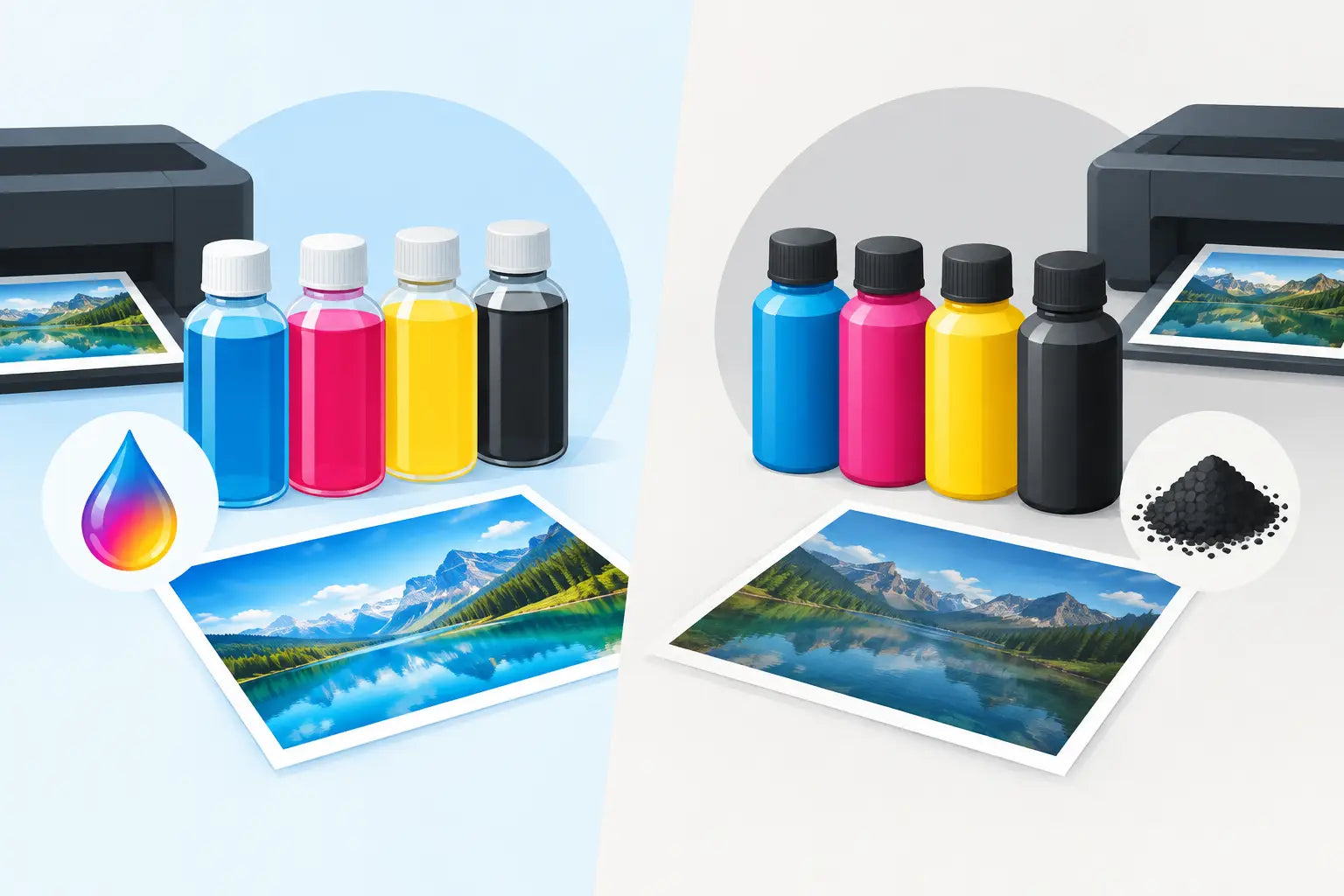
Dye ink uses colourant that dissolves into the ink liquid. When it reaches the page, it soaks into the paper fibres or coating. This allows colours to blend smoothly, which is why dye-based printers are often popular for bright photos, school projects and colourful everyday printing.
Pigment ink contains tiny solid colour particles suspended in liquid. Rather than soaking deeply into the sheet, those particles tend to sit closer to the paper surface and bind to it. The result is usually stronger resistance to water, light and handling, particularly on plain paper.
That basic difference affects almost everything else: colour appearance, print permanence, paper compatibility and the type of work each ink does best.
Where dye ink performs best
Dye ink is well suited to prints where colour vibrancy is the priority. On the right coated photo paper, it can produce smooth tonal changes, deep-looking colours and a glossy finish that suits snapshots, greeting cards, flyers and creative projects.
It is also common in affordable home inkjet printers. If your printer is mainly used for homework, occasional photos, travel documents and colour forms, dye cartridges can provide excellent results at a sensible cost.
The trade-off is durability. Dye ink can be more vulnerable to moisture and fading over time, especially if prints are exposed to direct sunlight. A dye-printed photo pinned near a bright window may not look its best years later. On ordinary copy paper, dye ink can also spread slightly into the fibres, which may soften fine text or leave colours looking less crisp.
That does not mean dye ink is poor quality. It simply means it is designed for a different job. Store your photos in an album, use suitable photo paper and keep important prints away from heat and sun, and dye ink can look fantastic.
Where pigment ink makes sense
Pigment ink is the workhorse for documents that need to stay readable. Black pigment ink is particularly valued for sharp text on plain office paper, making it a strong choice for invoices, reports, contracts, shipping labels and forms.
Because pigment particles are more resistant to water and fading, they are useful when documents may be handled frequently or stored for long periods. A café menu, a business record or an address label is less likely to run if it gets damp, although no print should be treated as completely waterproof unless the printer and paper specifications say so.
Many business-focused inkjet printers use pigment black ink even when their colour cartridges are dye-based. This hybrid approach gives crisp black text for daily paperwork while keeping colour printing economical. Some photo and professional printers use pigment ink across all colours, offering excellent archival performance and a more matte, fine-art look on compatible papers.
Pigment ink is not automatically better for every photo. On glossy paper, some pigment inks can appear less glossy than dye inks or create a slight difference in sheen between printed and unprinted areas. Modern pigment photo printers have improved greatly, but paper selection still matters.
Paper can change the result
Ink and paper work as a pair. The same cartridge can produce very different results on cheap copy paper, matte presentation paper and glossy photo stock.
Dye ink often shines on coated glossy or lustre photo paper, where the coating controls absorption and helps colours appear vivid. On thin, uncoated paper, heavy dye colour can sometimes bleed through or feather at the edges.
Pigment ink generally performs very well on plain paper because it stays closer to the surface, helping text retain clean edges. It also works beautifully on matte papers made for pigment printing. For glossy photo printing, check the printer manufacturer’s recommendations and choose paper made for your ink type where possible.
If you are seeing dull colours, fuzzy lettering or slow-drying pages, the problem may not be the cartridge. A mismatch between your paper, print settings and ink type is often the cause. Select the paper type in your printer settings before printing important work. That setting changes how much ink the printer lays down.
Print life, water resistance and everyday handling
Print permanence is where pigment ink usually has the advantage. Pigment particles tend to withstand UV exposure better than dyes, so they are commonly chosen for prints intended for display, filing or sale. However, real-world longevity depends on more than ink alone. Light levels, humidity, paper quality, framing and storage conditions all play a part.
Water resistance follows the same pattern. Pigment ink is often more resistant once dry, while dye ink can run or smudge when wet. But results vary by printer model, cartridge formulation and media. A label printed with pigment ink on absorbent paper is not necessarily suitable for rain or freezer storage. For demanding applications, use purpose-made label stock and test a sample first.
For everyday home printing, this distinction may be less dramatic than it sounds. A school worksheet does not need museum-level longevity. A photo album kept out of sunlight may be perfectly suited to dye ink. The best choice comes from matching the ink to the task rather than chasing the most durable specification every time.
Can you swap dye and pigment cartridges?
No. Use the cartridge type specified for your exact printer model. Inkjet printers are engineered around particular ink chemistry, printhead design and colour profiles. A pigment cartridge will not simply replace a dye cartridge because the colours look similar, and using an incorrect or refilled cartridge can cause poor output or printhead issues.
This is also why the cartridge code matters more than a cartridge’s physical appearance. Two cartridges can look nearly identical but use different chips, ink formulations or page yields. Before ordering, confirm your printer model and cartridge number. Inkspot’s printer-model search is useful when you want to remove the guesswork.
Genuine and compatible cartridges: what changes?
Both genuine and quality compatible cartridges can be available in dye or pigment formulations, depending on the printer. Genuine cartridges are made by the printer brand, while compatible cartridges are produced by third-party manufacturers for use in specified printer models.
The sensible comparison is not simply genuine versus compatible. It is whether the cartridge is made for your printer, provides the output you need and comes from a supplier that clearly states compatibility and stands behind the product. For routine documents, homework and office printing, a well-made compatible option can offer worthwhile savings. For colour-critical client proofs, exhibition prints or specialised archival work, genuine cartridges and manufacturer-recommended paper may be the safer choice.
Avoid mixing random, unknown inks just to save a few dollars. Savings disappear quickly if a cartridge leaks, produces unreliable colours or creates avoidable printer problems. Buy by printer model, choose a reputable supplier and retain your order details until you have tested the cartridge.
How to choose the right ink for your printing
Start with what comes out of your printer most often. If it is mostly black text, forms and business paperwork, pigment black ink is a practical advantage where your printer supports it. If it is colourful photos and creative prints on glossy paper, dye ink may give you the brighter finish you prefer.
Then consider where those pages end up. Documents that travel, get filed or may encounter moisture benefit from pigment ink. Photos for albums and occasional colour prints can suit dye ink very well. Finally, check your printer’s manual or cartridge listing. Your printer has already been designed for one formulation or a planned combination of both.
The most useful ink is the one that produces reliable pages for the work you actually do. Choose the correct cartridge for your printer, pair it with appropriate paper and keep a spare on hand before the next urgent print job lands on your desk.